Sports and Hobbies

A Salmon and a Dancing Hula Girl

Sun, 21 September 2008

Yesterday was a beautiful September morning. I convinced my friend Scott to get up early and join me for some salmon fishing off the mouth of the Genesee river on Lake Ontario. While Scott drove the Fish Fry I worked on setting the lines. As I was choosing which fishing rods to use, I saw the rig I took from my grandfather’s basement earlier this summer after he passed away. Even though it had 15 year old line on it, I asked grandpa if he’d help me out this morning with some luck. I put onto that rod, the lure I affectionately call “the dancing hula girl“. It’s a green Spin Doctor with an Atomik Fly (like this guy used) trailing behind it. It is a weird rig that I’ve never caught a darn thing on. I put down a good variety of other spoons and had the lines set by 6:45am.

Scott and I were chatting and not paying attention, and I looked over his shoulder from the drivers seat at about 7:15. I said “Hey, Scott!!! That’s a fish, could you go grab that?!” So he jumped up and grabbed the rod. With the line zipping out, I cleared the rest of the downrigger lines, then I grabbed the camera and shot this quick video:


Scott Ingraham catching his first big salmon

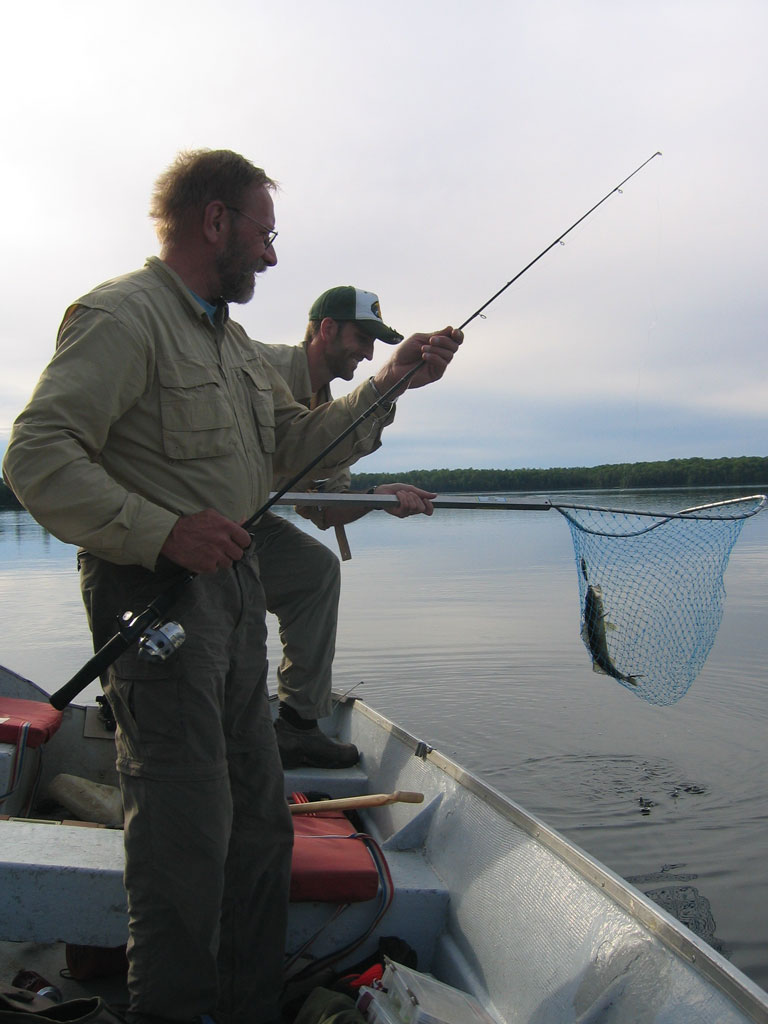
The fish fought for about 15 minutes, and at one point was more than 200 feet off the back of the boat. It was good to see Scott start to fatigue a bit as he got his first taste of horsing in a big one. Finally we tired out the salmon more than Scott, and unlike last year, I actually had a big enough net to get the fish in the boat.

Scott’s Salmon
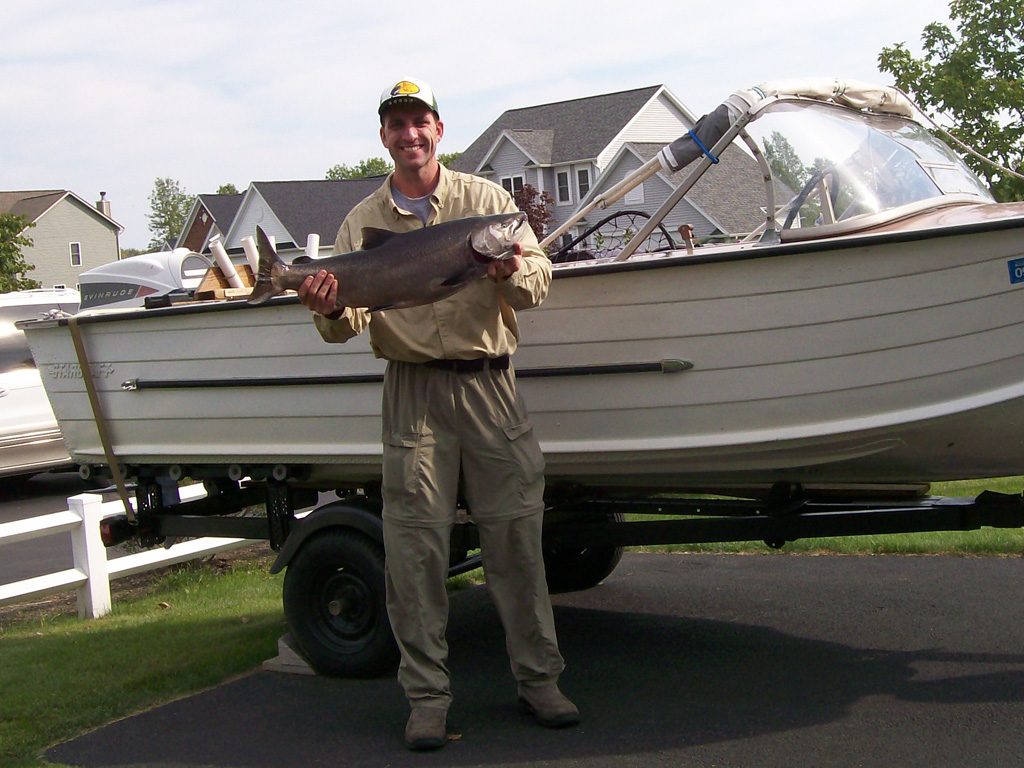
15 lb. King Salmon

Kris with salmon
Striking a pose with the catch of the day

It was awesome to find out that the fish came on grandpa’s rod, and the ‘Dancing Hula Girl’. Thanks gramps, that was pretty cool! Scott and I both had a big smile on our face the rest of the morning even though we never got another hit. I went home and cleaned our fish, then Tricia and I cooked it for dinner on the grill. Grilled salmon marinated in Santa Fe Marinade is mmm…mmm…good.

This was enough excitement to last me until next year. I think Scott was pretty pumped because when I dropped him off his vacuum packed fillets at church today (good charter captain I am) he still was sporting that grin. Thanks for a fun morning Scott!

Posted in: Fishing, Life | No Comments »

DIY Basement Workout Room Step 3: Electricity and Ceiling the Messy Way

Sun, 07 September 2008

With the wall insulation installed, it was now time for me to figure out the electricity for the basement workout room. I’m definitely NOT an electrician, so this posting isn’t going to give you any details on how to run circuits. I had a friend who knows what he’s doing stop by and help me plan out the circuits. Here’s a few decisions we made that might be helpful.

  • We decided on some 20Amp outlets for the treadmill and other heavy-load equipment.
  • The basement already had 1 lighting circuit, so we planned a second, new lighting circuit to be run from the box. We planned it as a 3-way circuit so that the workout room could be switched from 2 different switches entering and exiting the room.
  • We created a dedicated circuit just for the sump pump so that there would never be a potential overload on that circuit
  • My advice to you is to Google the different things you need to install + circuit diagram, and you’ll get VERY useful resources like this 3 way circuit diagram. These diagrams, plus my friend’s advice lead me to the store to get all the wire and boxes I would need.

    How I ran the Electric in the Styrofoam Insulation
    First, we needed to figure out how we’d attach electrical boxes with the lack of studs in the walls. Sure, I could have attached the boxes directly to the block wall and cut the Styrofoam panels around them. I wanted to poke as few holes in the Styrofoam as possible to retain its insulation factor. So, we chose to use old work plastic electrical boxes. These are the kind that get attached via tabs to the back of the dry wall instead of to the studs. While you may argue this is a less secure solution for the electrical boxes, it ended up being far easier to install and secure enough for my needs when all was said and done.

    The installation guide recommended running the electric wires behind the Styrofoam board. I wanted to be able to easily see my wiring paths so I chose to embed the wiring on the front of the styrofoam. First, I drew lines with permanent marker on the foam board to all of my proposed electrical outlet locations. I created a template out of cardboard that provided enough clearance for the electrical boxes and traced those in the electrical box locations.

    Here’s where the job got messy. To be able to easily cut the paths in the Styrofoam, I purchased a 5/8″ bit for my plunge router. Then I went crazy routing out the paths. Luckily I had tarped off the other parts of the basement, because the Styrofoam bits went everywhere! Make sure to wear safety goggles and a breather because the bits are not kind to your eyes or lungs. Have a look at the pics of me in action to get a sense of the mess.

    Routing out the Electric paths
    The paths were drawn in marker and I ran the router over the lines.

    Covered in Styrofoam dust
    A router can make a huge Styrofoam cloud

    To get the paths behind the furring strips just use a half inch drill bit and drill behind both sides of the furring strips. After all of the paths were routed out, I easily ran the rough wiring to all of the electrical box locations, leaving plenty of wire to finish things off after the boxes get installed with the drywall.

    Painting the Ceiling with a Wagner Power Painter
    While the walls were still bare it was time to make a crucial decision - how to finish the ceiling. We considered all of the various finishing options and finally arrived at an approach I’ve used once before; painting the ceiling with a Wagner Power Painter. Here’s why painting the ceiling makes a ton of sense for us.

    1. It’s a LOT cheaper. A tile ceiling with all of its associated hanging hardware would have cost $600-$1000. Painting the ceiling cost us two gallons of paint, about 40 bucks.
    2. It’s a lot higher. When I’m working out, I need all the space I can get for my monkey arms. Not having a drop ceiling saves us a precious few inches.
    3. It’s a lot more accessible. No ceiling tiles to mess with if you need to get at wiring or plumbing in the floor joists.
    4. It’s a lot easier and faster. Installing a drop ceiling takes a ton of time to install the grid work, cut the tiles, and soffet all of the irregular areas. Painting is a one shot deal that can be finished in a few hours.

    Choosing Your Paint Color
    Think of this ceiling method as the coffee shop, or industrial approach. We’ve all been to those trendy places with the exposed beams and pipeworks, same idea with your basement. I think the best colors to choose are anything dark. At my last house we used black. In this case, we used a dark gray. I’ve also seen dark brown and terra cotta - both look good. The ceiling just fades into the background not drawing your eye’s attention. What doesn’t look good in my opinion is a white or light painted ceiling. As soon as you enter a basement with the white painted beams, your eye is immediately drawn to it making it a lot more noticeable.

    Ceiling Paint Supplies
    If you choose this approach you’ll need a few critical supplies.

    1. Wagner Power Painter. Mine is the Wagner 5.4 Wideshot
    2. Floetrol or similar paint additive to thin your latex paint for spraying
    3. Latex Paint. I used 2 gallon of Eggshell finish for approximately 600 Sq ft.
    4. Rubber Gloves
    5. Protective head scarf, safety goggles and high quality breather
    6. Masking materials - tape, plastic, etc.

    Make sure to mask off anything that you do not want painted. Tarp doorways and passages to other rooms in your basement. Turn off your heat and/or air conditioner so that the fumes do not travel through the house. Open any basement windows you have for ventilation.

    Making the Big Mess
    Prepare yourself…this is going to make a big mess. By the time you are done painting, you will have paint dust all over your floors. Put the hood on your head, your rubber gloves on, and put on your safety goggles. Then fill your paint container with paint and some Floetrol and stir it up. Then go nuts spraying that ceiling. I like to have a scrap board nearby to take my initial spray shots so that the paint is flowing smoothly. Have a look at the pictures of Darth Painter to see it in action.

    Paint Vader 1
    I am your father…

    Paint Vader 2
    This sure beats painting with a brush

    Paint Vader 3
    Spray it on nice and thick to cover every nook and cranny

    In my next entry I’ll catch you up on our mudding and taping fun, show you the closet that will contain the sump pump, and I’ll show you the rubber floor installation.

Posted in: Home Improvement, Life | 2 Comments »

DIY Basement Workout Room Step 2: Insulating the Walls

Thu, 28 August 2008

Who knew that one of the most time consuming tasks in finishing the basement would be figuring out how to construct the walls. I agonized over the approach I would take, knowing that the wrong decision could cause me to tear down everything and start over. I hope my story here will help you make a good decision too.

The Walls I’m Working With
My house was built in 2005. We chose the particular lot we are on because it seemed like high ground with respect to other homes in the neighborhood. The walls are constructed of 12 courses of cement block which, despite my location, get saturated in different areas during heavy rains. I was shocked that a brand new basement could be so porous to water. I don’t get streams, but I would not say the basement is bone dry either. If we run a dehumidifier on high after a few days of dry weather the walls will dry out.

Last year I called EverDry in frustration, hoping that they could diagnose the water problem and propose a remedy. After the doom and gloom sales pitch of the dangers of deadly mold and crumbling foundations, their solution came out to a cool $17,000. It involved digging out around the outside of the foundation, trenching the interior perimeter of the basement and installing an industrial dehumidifier. This would guarantee dry block and also $17k less in my bank account. I decided to finish the walls without the massive expense, but the specter of water made my decision making far more stressful.

The Vapor Barrier Decision
The builder had originally planted the seed that putting a vapor barrier against the block walls (even if damp) leaving an airspace, and installing 2×4 studs would be a suitable way to finish the walls. I had a ton of questions about EXACTLY what to do though.

  • What kind of plastic should I use?
  • How far away from the walls should the studs be?
  • Should I install fiberglass insulation between the studs?
  • Do I need a pressure treated floor plate?
  • The most nagging of all questions: Will the walls get wet on the inside if I use this approach?

To answer my questions I followed Google to this great forum entry on how to vapor barrier a basement. There were some differing opinions, but THE BEST resource was referenced; Building Science Corporation’s Basement Insulation Systems Guide. Hallelujah! This is the advice given to builders on how to insulate/finish a basement. It has detailed pictures of the effects of what my builder had suggested (putting up a plastic vapor barrier and insulation)…it retains water and mold. MY solution was found on page 13 of the guide which explains the use of extruded polystyrene insulation and furring strips.

The Dow Styrofoam Solution
With a solution in mind I went looking for where I could find this extruded polystyrene (EPS). Lowes saved the day again. I found 2″ thick EPS sheets in either 4×8′ or 2×8′ tongue and groove sheets. Then I wanted to know how to install the stuff. Lo and behold the Dow website has this very thorough Dow Styrofoam Wallmate XPS Installation Guide. It gave me the plan I needed to purchase the rest of my materials, which included 1×3 furring strips for every 2′ and plenty of Tapcon screws.

A Special Note on the Tapcon Screws
For my project thickness the right size Tapcon screw was the 1/4″ x 3 3/4″ HEX head Tapcon screws. First, they are the thick ones to prevent any chance of them snapping on me when I installed them. Secondly, you MUST use the hex head for ease of screwing it into concrete. Don’t even think of using a Phillips head or flat head. Finally, buy a LOT of them, and NOT at Lowes. Tapcon screws are insanely expensive there, and these big ones run out of stock. I probably used 6-8 boxes of 25 screws each to do my single room. Buy them online in bulk if you can.

The Right Mix of Tools and Technique
It took me a couple of nights to get into a rhythm of how to best install the stuff. Let’s start with tools because they mean the difference between extremely slow, and super efficient. You’ll need:

  • Tape measure
  • Drywall square
  • Permanent marker
  • Utility knife
  • Spare 2×4′ board
  • High power CORDED hammer drill for drilling concrete
  • High quality masonry drill bit
  • Another electric drill for drilling countersink
  • Cordless drill/driver for installing Tapcon screws
  • Hand ratchet for finishing off stubborn Tapcon screws
  • Chop saw for cutting furring strips to length
  • Level to ensure furring strips and styrofoam are plumb
  • Ear protection
  • Work gloves

Tools for installing EPS Insulation
A menagerie of Craftsman tools helped me efficiently install the insulation

Working from one corner of the room, you begin by cutting the styrofoam to the height of the block wall so that it fits underneath the floor joists. To cut the material I marked a line with a framing square and permanent marker, then scored the line with a utility knife. The final step was to break the styrofoam over a spare 2×4 as shown below.

Breaking the insulation

Once a couple of pieces of styrofoam are dry-fit into place, you then cut a furring strip to cover the seem between them. Using a level I made sure that the furring strip was vertical, and had my trusty assistant hold it while I went for the hammer drill…

A Special Note on Hammer Drills and Bits
Not all hammer drills are made alike, and neither are masonry drill bits. Trust me. The first rig I used was my Craftsman 19.2V Cordless with the 3/16″ bit provided in the screw box by Tapcon. That was slow and painful. Then I thought I’d try my dad’s Black and Decker corded hammer drill from the 1980s thinking the electric power would help. Nope. I nearly burned out the drill. Check out the lean and grimace I’ve got trying to use that sorry rig.

Hammer drilling

So, I went to Kmart and bought a reasonably priced Craftsman corded hammer drill, and I went to Lowes and bought the toughest sounding 3/16″ masonry bit they had - the Bosch Blue Granite 6″ long Hammer drill bit. This combination cut through concrete like butta, and made this portion of the project take days not weeks!

Drilling and Screwing With Protection
I’m obliged to warn you that I used protection when hammer drilling and screwing. Muffs for the ears and gloves for the hands (padded for my pleasure). The sound reverbed throughout the basement and could have spread a WTD (Work Transmitted Disease). Without gloves, my hands would have developed some nasty sores. OK, enough with the stupid jokes…

  1. I drilled into the concrete
  2. I countersunk the hole
  3. I drove in the Tapcon with the cordless drill and hex driver
  4. I finished off the screw with a ratchet when needed

The end result is a securely fastened piece of Styrofoam insulation with Tapcon screws that are flush on the front so that drywall can be installed directly onto the furring strips without obstruction.

Countersink the furring strips
Closeup of furring strip with countersunk Tapcon screw

Finished Insulated wall
The insulated basement wall completed

This portion of the project took about 5 days, and the end result was actually really fulfilling. I could have very easily left the basement looking like this. It is now insulated, and the blue looks much better than block. Unfortunately I think there is some code that says you need to cover over the Styrofoamwith wall board for fire protection. Well…that and we can’t have Tricia’s clients working out in a half-finished room, now can we?

Next up…how I installed the electricity and painted the ceiling with a Wagner Power Painter.

Posted in: Home Improvement, Life | 4 Comments »

DIY Basement Workout Room Step 1: The Plan

Thu, 07 August 2008

1037 Castle Bridge Basement Plan

My web activities have slowed to a crawl as we have begun yet another home improvement project in the Rzepkowski household. This time we are finishing an area of our basement to serve as a workout room for Tricia’s personal training business. My web marketing strategery caused an inflow of clients a few months before she may have been fully prepared, so here we are in the middle of the best part of summer locking ourselves “down in the hole” to prep some much needed home fitness space.

I’m going to post a series of entries outlining the project. I’ll try to write down as many notes-to-self as possible so that I don’t make the same mistakes again the next time I go to do some DIY home improvement. If you learn from any of the choices I make, awesome! If you want to comment on what an idiot I am, go for it! I’m way behind on documenting the steps I’ve already done so your advice will likely fall into the too little too late department. Without further ado, let’s get going…

What Are We Going to Do?
This whole thing started with a simple wife whimper, “Honey, I really need a wall between this one part of the basement and the other part so that all the kids’ junk isn’t in the way of my workout sessions.” I said, “OK, a simple stud wall with a door opening will be no problem. Let’s just put it up. So, I got the car keys and just as I was stepping out the door to go to Lowes I thought, “Gee, maybe I should measure a few things.” I brought my expert consultant to the basement and we literally moved furniture around for an hour trying to figure out how to configure the space.

Visio 2003 Beats the Back of a Napkin
After we tired ourselves out, we decided a floor plan was in order. I popped open Visio Professional 2003 on my computer and draw up a plan of the space and the big items we needed to fit. That way the heavy lifting would be done on the computer, not with our back. The plan you see is by no means an expert architectural blueprint. I misused and abused Visio because I didn’t want to spend the time to learn how to do it 100% right. I wanted to get building the friggin’ basement, not become a Visio Jedi Master. Nonetheless here were a few brief tips on how I made a simple drawing above out of Visio.

  1. Create a New Drawing by going to New > Building Plan > Floor Plan. This opens a ton of VERY helpful Visio shapes for creating walls, staircases, furniture, dimensions, etc
  2. Set the Scale under Page Setup > Drawing Scale tab. Measure you long outside walls and fiddle with the scale so that the entire drawing will fit on 8.5 x 11. Trust me, you at least want to do the drawing to scale. This is extremely helpful!
  3. Use the shapes in the Dimensioning - Architectural palette to show precise measurements on your drawing. These measurements allow you to measure on paper for everything from studs to wiring.

The left side of the drawing is what we are currently building. The rest (including the bathroom) are for a future phase. Learn about the tough decisions we made on insulating and waterproofing cement block walls in my next posting.

Posted in: Home Improvement, Life | 1 Comment »

Thousand Islands Mini-Vacation

Wed, 30 July 2008

For our 10th anniversary weekend we headed off to Chippewa Bay in the 1000 Islands for a couple days of fun with our friends Marc and Janet and their kids, Mia and Lucas. On Sunday morning we hooked up our boat and left the house at 9:45. We took a really nice drive east on 104 through all of the eastern Lake Ontario fishing towns like Sodus, Pulaski, Oswego, and Mexico. We arrived at around 12:30pm at the public boat launch. There, we left our boat trailer locked up and drove the boat over to the cabin which was less than half a mile away.

Jesse’s Island
The cabin is at the end of a steep road to the water’s edge. On the land where we stayed was the owner’s cabin, and a guest cabin that the 8 of us stayed in. The cabin is on Jesse’s Island, which I would suppose is one of the 1,793 islands that make up the area.

Mia and Anna on Jesse’s Island

Here Fishy Fishy
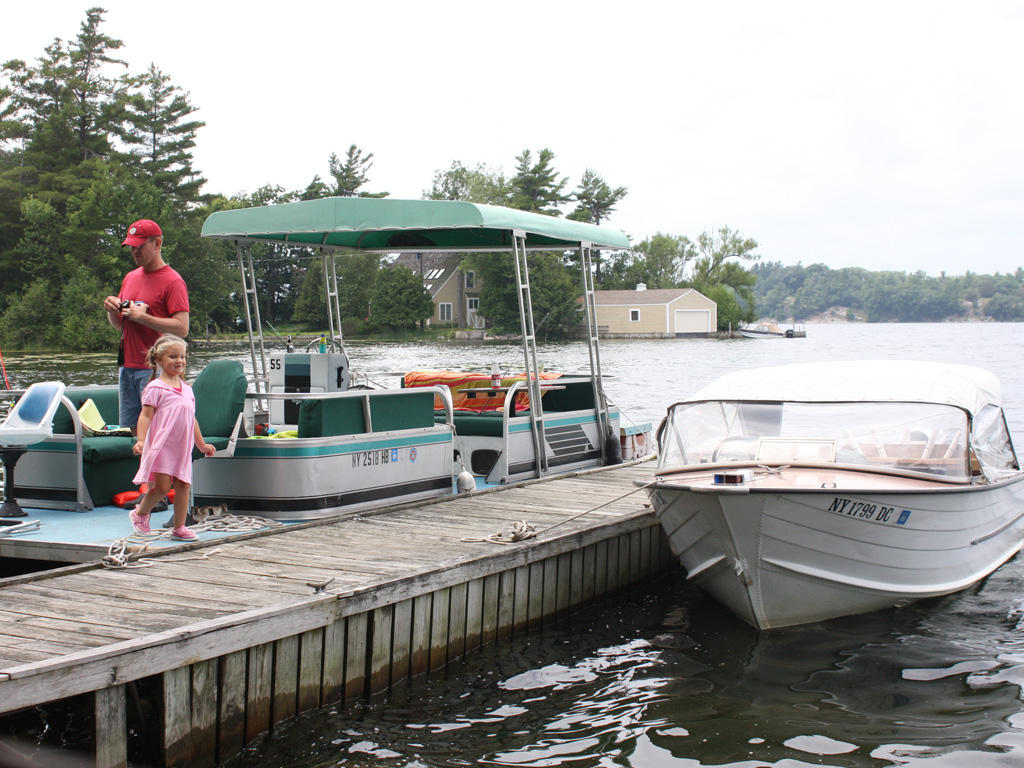
The 2 boats at the dock
I brought the Fish Fry, but the best “yacht” in the place was the pontoon boat
We took the boat out fishing while Marc’s family went on the 24 foot pontoon boat they had rented. We spent a good amount of time out on the water drift fishing with worms. We got tons of small perch. As we peered over to the fishin’ barge we saw Janet hook a nice 3.3 pound walleye, and a small Northern Pike. We knew who we were fishing with the rest of the trip for sure. The pontoon boat worked out much better to get the whole crowd of us to have fishing fun together.

Anna pets a Northern Pike
Anna pets the nice Northern pike lovingly.

Island Hopping
Perhaps the best part of going to the 1000 Islands is island hopping. There was a nice state park right by where we fished every day, so it gave us a chance to explore. The island had a few tent sites and a beautiful picnic shelter. Someday, it might be fun to camp there.
Cedar Island State Park
We parked the boat on shore and poked around the island.

Mason and Anna Go Down the Tubes
On Monday afternoon the weather was kind of crummy and we had been fishing all morning. Rather than sit inside, I thought we could try a water activity. Heck, we were going to get wet anyway. I had purchased an inexpensive tube and tow rope from Dick’s to bring with us on the off chance that I might entice one of the kids to hop in the water and get dragged around by the boat. Sure enough, Anna was game for the adventure, but Mason wasn’t feeling well.

We took out the pontoon boat, hooked up the tube, and I hopped in for a trial run. Anna saw me getting dragged around having a good time, but was a little concerned when I flipped off the tube after doing some tricks. Nonetheless, she hopped into the tube giving me explicit instructions not to go fast or do tricks to flip us off. Well, I had Marc start off really slow. After a while we sped up a bit more, and Anna was having a blast! We talked the whole time together about how much fun we were having. Then I had Marc goose the throttle a bit more so we could get the tube on plane and get my legs out of the water. That’s when Anna had enough. She started to scream like she does on a kiddie coaster, “This is a nightmare!, This is a nightmare!”. I just thought that was priceless. So, we slowed down and congratulated Anna on her first tube ride. (The pictures are still on Marc’s camera). It was awesome!

Mia and Lucas both had their first turn on the tube as well (with Marc and Janet riding along). They both had a blast in their first experiences too. We went in after the first round of tubing to pick up Mason and Tricia. Luckily Mason was feeling better and he wanted to give tubing a whirl. Tricia was the first to take him out. She had the boat up to full speed, and had Mason outside of the wakes! He loved it. Then it was my turn to go out with the boy. I got even more aggressive with it at full speed, and he just never wanted to quit. Nothing beats the smiles that the whole crew had on their faces.

Mason and Tricia Tubing
Tricia takes Mason on his first tube ride

Kris and Mason tubing together
Kris and Mason go outside of the wakes

Tourist Fun
We also had a chance to check out a few spots in the tourist mecca of Alexandria Bay. My favorite, of course is the 1000 Islands Bait Store, the ultimate fishing shop. My kids really liked our scavenger hunt at Mazeland. Mazeland is a labyrinth of bushes that you try to find your way through. You go through it looking for letters that make up the word of the day. If you get the word of the day right, the kids get a prize, and the adults were entered into a drawing for one too. Mason enjoyed the life sized chess board in downtown Alex Bay. When we got back from the trip all he wanted to do was learn to play chess. That is one of his new favorite things.

Krolczyk family at Cedar Island
The Krolczyk clan in their favorite part of the world

Thanks to Marc, Janet and the kids for sharing their yearly family vacation with us. It was a lot of fun.

Posted in: Fishing, Travel, Family and Friends, Life | No Comments »

4th of July 2008: Fireworks, Family and Poppy in the Sprinkler

Sun, 13 July 2008

For the fourth of July, we had some good times at Conesus Lake. Much of the Rzepkowski clan came into town to enjoy the Ring of Fire on the 3rd. Wendy and Ian even drove up from South Carolina, and with them came both of my grandmas and Barb Polasik, my grandma’s cousin from Virginia, who is just a terrific lady.

A Flame Lit for Lefty
At dusk we started off the fireworks show by writing messages to grandpa on a Chinese lantern. We had a lighting ceremony with some prayers and then sent it off into the sky. We expected it to go thousands of feet into the sky and see its way to heaven. Instead it went about 100 feet, then came down like the Hindenburg. It was still very touching, and beautiful.

Neal with Chinese Lantern
Uncle Neal lights the Chinese lantern. If you look closely you can read the messages to Lefty

Ian also brought with him about $300 worth of fireworks that we lit off at the end of the dock, adding our own personal show to the thousands of crazies trying to outdo each other.

Fireworks at the lake
One of the many fireworks shot off at the lake

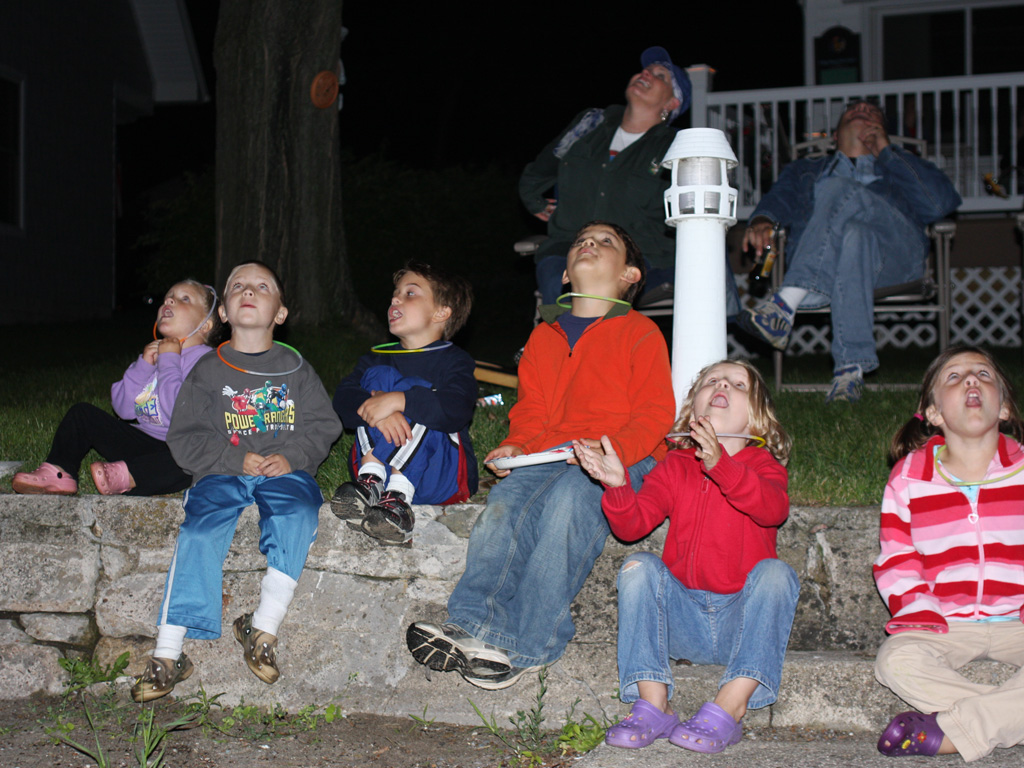
Childrens-ahhs
The children’s ahhs tell the whole story

On the 4th we made a HUGE breakfast of Belgian waffles and egg casserole. Then, Ian, Dad, Mike and me went to Livingston Country Club for a round of golf. I was on my way to my goal of breaking 100 for the first time. But, at hole 15 my stamina went out the door, and I had 7’s and 8’s for the rest of the round, leaving me with a 111. Luckily we are all in the high-scoring club so that was good enough for second place.

Golf at Livingston Country Club
Dad “executes” a 60 ft. putt while Ian provides the typical hi-jinx

Th rest of the weekend we had great weather, so we took the kids swimming in the not-so-warm water and went on a nice long boat ride. There was plenty of drinking and fishing to keep us occupied too. As is our tradition, we topped it off with our yearly family photo in the Old Navy flag tees.

flag-tee-photo

At Nana and Poppy’s House
After our trip to the lake we went to Nana and Poppy’s house for some more relaxation and Mush for dinner. It was hotter than blazes on that Sunday, so the kids convinced Poppy that they should all go in the sprinkler. That set us up for some ideal photos of grace and beauty in action. Have a look:

Poppy and Mason in the Sprinkler
Poppy and Mason having fun in the sprinkler

Poppy and the kids in the sprinkler
Grace in action: Poppy and the kids jump through the sprinkler

Happy 4th of July everyone!

Posted in: Golf, Holidays, Life | No Comments »

Cabonga Reservoir Fishing 2008: Family, Fun, and Foibles

Fri, 20 June 2008

Kris Netting Fish Cabonga
Kris nets nice walleye for Uncle Neal

From June 9-13, 2008 I spent a week making a trek up to Canada with my uncles, my cousin, and some family friends to Cabonga Reservoir, for some great walleye and pike fishing. More importantly though, it became a great way for us to unwind and connect in a positive way after spending the previous weekend doing something very hard for our family. I always provide the entertainment for the group with my knack for idiocy. This year was no exception.

Kris’s 2008 Cabonga Fish Story
It was prime time fishing in the evening, ’round about 7pm. I was in a boat with Phil and Duane. We had just found out the secret to the best fishing lure from the local Indian guides. We trolled Thin Fins so fast that the boat was putting up wake and we were nailing the fish. Alas, as is typical after buying a new lure, I got it well snagged on the bottom after only about 10 minutes using it. Duane offered to use a Snag-away to release my lure from the bottom. He monkeyed with the contraption for 5 minutes unsuccessfully.

Now, I was getting frustrated. I was wasting valuable fishing time with this snag. I told my boat mates I would snap the line. What was really going through my head was “I’ve got one more shot to save my lure if I yank REALLY hard on the rod”. So that’s what I did. Suddenly I heard a twayayayanggggg….noise, and then a sploosh! It took me too long to realize that the top part of my Ugly Stik rod, that was always loose to begin with had just flung 50 yards behind me. Since I was the driver of the boat, I quickly grabbed the tiller, flung it into reverse and went after the tip of my rod. Of course they don’t float, but I wasn’t bright enough to think this through. Instead I proceeded to gun the engine and take on water into the back of the boat. At this point Phil and Duane calmly suggested that I step away from the tiller until I cool down a bit. They also stayed pretty quiet for a while as I grumbled about losing half of a good rod to the fishing gods. All I can say to everyone in attendance is, “You’re Welcome! Tip me at the bar, I’ll be here all week.”

Uncle Neal’s Rock Split Incident
My fish story only barely beat out Uncle Neal for Best in Show. His entry was more ballet than my slapstick, but still high quality nonetheless. The boats had split up for the afternoon, and my boat was 100 yards from where we saw Uncle Neal’s boat approaching some large boulders. I knew that they were stopping by these large rocks to have a snack and rest. When I looked over my shoulder to see them dock at the rock, all I saw was a splash, and what I thought was Uncle Neal going into the water. I cried “Man down!” to my boat mates, and we quickly went over to see what happened. When we arrived, there was Neal with one soaked pant leg all the way up to his butt. Apparently he had tried to prevent the boat from making too hard of a landing at the rock. He put one foot on the boat bow, and put his other out to fend off the boat from the rock. When the boat lost its forward momentum it quickly left Neal with a “Split Decision”. The boat moved away from the rock and he had to make a quick call to jump back to the boat, onto the rock, or into the water. He chose the boat, but he lost his balance and dunked his leg in the water.

It’s always those great stories that makes the trip so fun. There was plenty of great walleye fishing too. In fact, the last night the fish were hitting from 5pm all the way through 8:30. It was one of those perfect nights. Warm, calm, quiet, and the fish were in a frenzy. Our stringers were full by 7:45 and we spent the rest of the night upgrading our tonnage to only the bigger walleye.

I enjoyed the trip immensely, and the time off is always good for a recharge. Here’s some more photos from the 2008 Cabonga Fishing Trip.

Posted in: Fishing, Family and Friends, Life | No Comments »

DIY Deck Stain Weekend the Sherwin-Williams Way

Fri, 02 May 2008

The year of the deck continued as we took advantage of more summer-like April weather to tackle the dreaded deck stain project. This came just a week after we completed our deck skirt to keep the critters out. We knew a year ago when we had our pressure treated deck built, that the time would come for sealing and staining it. After all, we saved 2/3rds of the cost of no maintenance Trex decking by having it built of wood. After a full year of aging, the wood has cured well enough to receive stain.

A friend of ours recommended our local Sherwin-Williams store for getting our supplies rather than Lowes or Home Depot. He said that the staff there could provide a lot more expertise about the right approach and products for a deck than the others. All I knew was that I wasn’t interested in sealing and staining the deck in 2 different steps. I wanted a product that would take care of business all at once.

Ask Sherwin-Williams
I had that commercial in my head as I went in to get a consultation. The professional behind the counter must have spent 35 minutes with me explaining all my options in deck stains. He explained that I actually did not need to clean my deck unlike most poor saps that are restoring some gray weather-worn disaster. I wanted to see the wood grain through the stain, so I knew I did not want a solid. The guy suggested an off-the shelf honey colored Deckscapes toner (I forget the exact color). There were many colors to choose from, but like regular paint, once a color is mixed you can’t return it. Then, he told me the best way to apply the stain - a 5 inch wide brush on an extension pole so I wouldn’t break my back. For the spindles and other hard to reach places, it was going to be good old-fashioned brush work and lots of it. Finally, he was able to estimate number of cans I would need to complete the deck and our playset - 5 gallons.

I brought the stain home and brushed it onto a test piece. We really didn’t like it. There was barely a discernable difference between the stained wood and that which was not. Tricia convinced me that if we were going to do all of this work that we had better notice the results. So, I wandered back to the store with a test piece in hand and a picture in my head of a much darker brown hue with a hint of red. I must have hemmed and hawed another 45 minutes about the color. I tested cedar which was way too orange. Finally I settled on DeckScapes Exterior Waterborne Semi-Transparent stain in a custom color - Riverwood. Once he mixed it, there was no turning back. I had almost $200 in stain on the table, and no place for it to go but on the deck, like it or not.

Railings are No Fun
We started first with the railings and spindles figuring that we would not want to be walking around on a drying deck surface trying to get at them. The stain had a knack for dripping, but we managed to get a good coat of it on without making too much of a mess.

Floorboards are Easier
Once we got to the floor, life got a little bit easier. My helpers applied stain with their smaller brushes, while I came in after them with the 5″ wide brush we affectionately called ‘The Beast’. Mason wielded the ‘mini-Beast’ (the 2.5″ brush) to help mommy and daddy for the first time with a big project. Anna stayed inside much of the day with her chicken pox.

Kris and Mason Stain the Deck
Kris with ‘The Beast’ and Mason with the ‘Mini Beast’ staining the deck

We were putting the last touches on the first coat of stain in the darkness of day one. When we came out in the morning on day 2, we could see where the stain was uneven on the final few floorboards that we stained in twilight. I think it had as much to do with having painted ourselves into a corner (and switching techniques) as it did with the darkness. I made the call to put on a second coat on the floorboards only so that we had a nice even look to things. That only took about 3 extra hours to accomplish. We did not stain the deck skirt. We’ll likely wait until the fall so that the wood has time to cure. The deck looks awesome now. The stain will definitely give us a couple of good years of protection before we need to do it again.

Tricia stains the deck
Tricia staining the deck with the playset project looming in the background

After we completed the deck, we moved right into the playset. Because it was built of pressure treated 2 years ago, the wood was much more thirsty. This coupled with far more intricate surfaces to cover made the project last the rest of the day. When it was all over, we had a matching deck and playset that should last a lot longer now that they’ve been protected.

Posted in: Home Improvement, Life | 1 Comment »

DIY Pressure Treated Deck Skirt in 4 Days

Sun, 13 April 2008

Winter has finally released its grip on Rochester, so we decided to attack an annoying outdoor project before we get to having any fun. Since building our deck last year, a variety of animals have found our deck to be the perfect place to hide out. We’ve provided refuge to a family of robins, a rabid possum, moles, mice, and bunnies. We decided to skirt the deck to take back our back yard from the wild kingdom. As a side benefit we thought a skirt would provide a more finished look. The rest of this entry will chronicle some of the decisions we made and steps we took to complete the project.

Deck before skirt
Our deck prior to building the skirt

Deck prior to skirt from another angle
Another angle shows the perfect haven for furry critters of all kinds

Day 1: The Shopping Trip
We took some measurements of the deck and made a quick napkin sketch to take to Lowes for some ideas. The maximum height of the deck from the top to the ground was around 32″. We headed first to the lumber department to check out lattice. We knew though that the holes would be big enough to allow mice, moles, and eager birds through it. This just wouldn’t do. When we costed out the number of board feet it would take to use deck boards instead we nearly had a heart attack.

Our epiphany came in the garden department where we found stacks of Dog-Ear Wood Fence Board. The wood is rough cut and intended for fences. The advantage of the material is how thin it is which would fit nicely under the overhang of the deck boards. At $1.69 for 6′ boards we figured we could get 2 slats per board. It would take about 70 boards to face the entire deck which would cost just under $120.

Boards and stones for deck skirt
Fence boards and stones ready to be installed

Next we needed to figure out what to attach the slats to along the ground. I ended up with a very simple idea. We would stake 2×4’s horizontally into the ground. I purchased (6) 12′ 2×4’s for this purpose. To provide one more critter barrier I thought a bit of stone installed beneath the skirt might frustrate those trying to dig under the skirt. For this, we bought 20 bags of drainage rock.

I didn’t need to buy any screws because we had a ton of FastenMaster Deck screws from building the kids’ play set. These screws have square heads and will not corrode in the new kind of pressure treated wood.

Day 2: Figuring out the Technique
The first real day of construction took the longest because I needed to build the base plate into which we would fasten the bottom of the skirt. Using my chop saw, I first cut 18″ stakes to drive into the ground.

Cutting the stake for the base plate
18″ stakes would hold the base plate

I used a plumb line to establish the face of the skirt and left 1.5″ of space behind the plumb line for the 2×4 to fit. After pounding the stakes in with a sledge hammer, I put stone underneath where the base plate would be attached. Then I attached the base plate to the stakes.

Base plate for deck skirt
The base plate is installed along the ground.

With the base plate in place we were able to begin installing the skirting. We started under the stairs; working our way from the most complicated end to the least. Under the stairs we had to notch some boards to match the rise and run. The length of the skirt boards varied slightly as the distance between the top of the deck and the ground changed. We butt the boards against one another, knowing that as they dry they will shrink. At one point there looked to be a tilt to the boards left to right, so we began to use our level to ensure each board was true. By the end of the first night I had completed part of one side.

Days 3 and 4: Getting in a Rhythm to Finish the Job
The third day was a Saturday, so we could count on a full day of work. We set up our work site with an electric drill for pilot holes and a cordless drill to drive the screws. Tricia could bark the lengths of the boards to me for cutting while she was installing the boards. We made it through 2 sides of the project before we couldn’t bend over anymore.

Kris Cutting Skirt Boards
Kris cutting deck skirt boards

Tricia installing deck skirt boards

Day 4 we rounded the last corner of the 20×25′ deck and installed the last board. To make absolutely sure that no animals would get through our fortress we plugged up any small holes between the skirt and the house with foaming insulation. Overall, we are very pleased with the project. It was straightforward, simple carpentry with very few challenges. The skirt makes the deck look clean and finished. We will give the wood a year to rest before we seal it.

Completed deck skirt
The completed skirt provides a critter barrier and gives the deck a finished look

Posted in: Home Improvement, Life | 4 Comments »

DIY Crown Molding Day 6: Fit and Finish

Wed, 12 March 2008

Final Crown Molding Installed

To call the finishing stage of the crown molding project all one day is a bit of a misnomer. The reality is that it took small parts of about 4 days to caulk and do the finishing touches, all adding up to about a day worth of effort. I went around the room sealing the gaps between the molding and the ceiling and the molding and the wall with DAP Alex Plus Caulk. It is a latex caulk that can be painted. I also needed to fill in each inside corner, and the outside corners so that there were no visible gaps between the pieces of wood.

Perhaps the most challenging part of the finish work were the 3 joints in the room where I had didn’t have enough molding length to span the entire wall. On those joints as well as every place I had nailed, I used DAP Fast N’ Final Spackle. I put many thin coats of spackle on the joints, then let it dry, sanded and applied it again so that it would in theory disappear. Well, after about 4 layers, I gave up trying to get them all perfectly smooth. In retrospect I wish I had made tighter joints to begin with, but we learn.

After all of the filling was complete I took out the trim paint and painted over the caulk and spackle. My last step was to take out the wall paint and touch up any spots on the wall where white caulk was too visible.

Finito
The best part of the project is that it is now done. The results are great. It looks like the crown molding has been there all along, and really provides some nice architectural detail for the room. The project wasn’t overly difficult. It just took patience and a tolerance for having the house and garage in disarray for about a week. The total bill for the project was probably about $250 which included molding, paint, screws, caulk, book, angle measuring tool, etc. It will probably be a bit before I do another room, as I want to let the memories of coping corners fade a bit, but I wouldn’t hesitate.

DIY Crown Molding Project: Day 1 | Day 2 | Day 3 | Day 4,5 | Day 6

Posted in: Home Improvement, Life | 1 Comment »

lifecategories

wifeblog

firstgraderblog

dailyReads

wishlist

from kaboodle
aboutkris

This is my Life as a 33 year old husband and father of two and my Work as an Interactive Marketing Director currently telecommuting to Hudson in Chicago from home in Rochester, NY.
more about me...

archivedkris

shades of k © 2000-2007, Kris Rzepkowski | powered by: WordPress, hosted by: Bluehost