The Rz-Team Deer Hunt 2008

Sun, 23 November 2008

Last weekend was one dedicated to our friend the white-tail deer. With an amazing buck adventure already behind me this season, I was really looking forward to helping my Dad bag a deer, and Uncle Terry get some action. He flew up from Florida to the frozen tundra to enjoy the changing of the seasons – archery to gun season that is.

Terry came into town on Thursday, so he’d already had an entire day in the woods by the time I got to Conesus Lake, where we hunt. That night he told stories of watching a buck in the woods mill around all day long just outside of bow range. The only shot he took was this nice photo.


Apparently this buck was more interested in napping than grunt calls and rattles

With visions of bucks dancing in our heads we all turned in awaiting our first day.

Friday’s Balmy Bow Weather
I took Friday, the last day of archery season off from work. We were in the woods at sun up in what turned out to be a 60 degree November day. The deer agreed with us that it was a better day to sit out in the sun in shirt sleeves than to be walking around the woods. By 10am we had seen nothing, so we called it a morning. For the rest of the afternoon we played with guns – always a manly activity. We went down to my Dad’s barn and sighted in our shotguns for Regular season. I was the only guy to hit the paper plates consistently at 50 paces. While I thought that was a good omen, it actually was not a predictor of what was to come. In a critical strategy move, we also threw up a small ladder stand right where we’ve been seeing deer come in and out of the woods all season. THAT ended up being our best decision of the weekend.

Our Friday night hunt came soon enough as the days don’t last too long this time of year. For the 4th straight session, Dad didn’t see anything in his stand. We were all shocked at how his stand went cold after we kept seeing SO many deer there earlier in the season. At 5pm on the dot I scooted off to a volleyball game at Hot Shots. Terry was conspicuously silent on the radio when I told the guys I was leaving. When I came back to the lake later on, I got the scoop on a miss that caused Terry a sleepless night. At 4:45pm, before the radio call, a doe had meandered toward the ladder stand VERY slowly. It took until 5:05pm for it to get close enough for a perfect shot. As Terry recounted it, the shot was completely dialed in to the heart. Our resident master of the perfect shot was getting pretty cute with his technique, no doubt wanting to show us how an arrow can be put into the size of a silver dollar from 25 yards. When he let the arrow fly it went straight and true directly…into the ground. As Terry put it, the hunting target he uses is flat and a deer’s underbelly is round. It likely took off a couple hairs from that round part of the real deer, and that was all. That little incident has Terry thinking about larger target areas for next season.

Freezing Cold and Driving Rain. It Must Be Opening Day!
The opening of Regular Season was upon us Saturday morning and I knew the weather was going to be awful. Unlike most opening days, we saw no deer activity, and heard very few shots. By 9am my blaze orange cotton jumpsuit was soaked and bloated like the Michelin man, and Dad was wringing out his gloves.


Kris exiting the woods after a lovely morning in the rain

We headed in to dry off, and Terry-of-many-gadgets stayed out in the woods underneath his umbrella. At about 3pm Dad and I returned toasty and rested. The rain stopped, and you could hear a pin drop for most of the afternoon. Then, right about 5pm BOOOOMMM! Terry’s 20 gauge rang out from the lower stand and then a second shot. I quickly flipped on the radio. Terry said “Look out in the bean field, the doe’s coming your way!”. I didn’t see it, didn’t see it, then I saw it…a deer came out of the woods into the field. I radioed “I see it, what do you want me to do?”. Terry said, “Is it down?”. In that time I had lifted the gun and put the sight on the deer. I squeezed the trigger and KABLOOM my 12 gauge rang out. The deer dropped in its tracks. I observed for another few seconds, then got on the radio and said, “NOW it’s down!”.


A long trip from Florida ended up providing a big smile

After no action for 3 straight days that was quite a flurry of excitement. I was happy to be Uncle Terry’s wingman and put in the finishing shot. We had to do NO tracking. THAT would have been a great result of the day that was yet to come. We field dressed the doe then took it back to the house where we hung it on my Dad’s car hoist.


“Hanging around” the doe prior to our fish dinner at deer camp

There, I gave lessons to the guys who taught me to hunt on how to undress and quarter a deer. We had it in the fridge by 8pm. I finished off the night be frying up some walleye from our 2008 Cabonga Trip.

Gale Force Sunday and a 5 Hour Odyssey
Sunday, we were all somewhat pessimistic on our prospects. 40 MPH gale force winds and 25 degrees rounded out our weekend of weird weather. I went out to the ladder stand before sun up with Uncle Terry in the high stand 100 yards away. At ten to seven with the light just getting bright enough, and a stiff wind in my face, I saw 2 deer crossing the bean field behind me at what must have been 60-70 yards. With my knees knocking I braced myself in the tree and took aim. The deer which I thought was a doe inched closer and came into the opening that I considered to be in good range. I squeezed the trigger and the cold morning air was split open with the crack of my 12 gauge. The deer moved a few more feet and I took a hurried second shot which apparently missed, and the deer scooted off into the woods.

The best part of the shot was that it came right after Terry had radioed me that it was OK to shoot into the woods (the other hunters around us had not shown up for the day). It seemed to him that I was waiting for his permission to shoot, and BOOOMMM I wasted no time.

I was hoping that Terry would come down out of his tree in time to get a shot at the second deer which was still hanging around 5 minutes later. Unfortunately he and his Fall Guy had a fight in the whipping wind causing him to get stuck in his tree. By the time he arrived on the scene, the trailing doe was gone.

It didn’t take us too long to pick up a heavy blood trail into the woods. We radioed my dad on our progress after we followed the doe an initial 100 yards. He stayed in his tree until 9am after we already tracked the tenacious doe through thick brush, pines and a meadow. The blood trail went from large pools of blood to pin-head spots and back again. We thought for sure I had gotten a really good shot because of the ease with which we could follow the trail at certain points. After 2 hours we kicked up the deer in a heavy golden rod field, and for the first time found out it was a spike buck. We saw the antlers and a pronounced hobble in the deer, but it managed to scurry away. Getting increasingly frustrated from what was already 2.5 hours of tracking, we asked my dad to make the long journey from his stand to where we were in the field. We thought for sure we would stalk the deer for only a few more feet and would find it. Not so much!

Thank Goodness for Dad’s Fresh Set of Eyes
When Dad arrived, we trailed the deer another 300 yards across another meadow, into new woods, and down into a gully to a stream. The last blood was right before the stream so we thought for sure it had crossed and went straight up the other side. No blood. We searched 3 fresh trails near the river’s edge. No blood. We back-tracked the trail, no blood. For 1 hour we looked for any sign of blood, ultimately ending with a grid search. What was a steady trail suddenly vanished. Tired and inexperienced on these long trailing expeditions I had pretty much given up. Not my dad. Some 50 yards down the stream bank, suddenly he yelled “BLOOD!”. The deer had walked downstream and exited the water there. No sooner did we follow the trail another 30 yards, and we scared up the deer again. This time Uncle Terry trailed the deer aggressively, trying to tire it out. Finally, he got on the radio and said he could see it and get a shot. I told him to take the finisher just like I had done for him the night before. BOOM! At noon the tracking was over in a reedy bog, deep in the woods. We were probably a mile or more from my first shot.


What a relief to have caught up to this buck; a magnificent animal.

When we examined the deer we found 2 unusual things. The first was what a crummy shot I had taken. I got the deer in the back leg which caused plenty of bleeding, but is not a vital hit. The second was the fact that the deer was missing one of its antlers after I had seen 2 earlier. Apparently the world’s most fluky finishing shot had sawed off the second antler.

Dad went down the road to get the truck and in the meantime, Terry and I field-dressed the deer – only my second buck ever. We had to get permission from a farm well down the road from our hunting grounds to allow us to drag it out. I’m not proud of the poor shot I took. I am however very proud and grateful to my Dad and Uncle Terry for helping me fulfill the promise of being good sportsmen in the field.


A great deer hunting team. This day tested the mettle of all of us

The first few days of the week I spent processing the results of our productive weekend. My father-in-law was great to help me out with that task which I’ve now begun to enjoy. We already have our sausage back in time for the Thanksgiving holiday. I’m bummed my Dad didn’t get one this year because he certainly put in his time. It was a great hunt nonetheless, showing how great team work leads to a memorable experience no matter who takes the first shot. I’m looking forward to next season already.

Posted in: Hunting, Life | 2 Comments »
Share/Save/Bookmark

My First Buck – a 7 Pointer!

Tue, 28 October 2008

Archery season for deer started last weekend in Western New York, and my dad and I have spent a lot of time already chasing after our white-tailed furry friends. This past weekend, Dad decided to take some time to spend with Mom (a smart idea). Since Tricia and I weren’t doing much after our High School Musical 3 fun with the kids, she told me to go sit in the woods. So, that’s just what I did early on Sunday morning. I saw plenty of deer – even a couple of bucks – 100 yards from my tree stand. Frustrated by everything being too far away, I took a trip to Gander Mountain to get some “attractant”. Literally some doe pee.

Yep, they bottle deer urine. I don’t want to know how they collect it.

Sunday Night Special
Sunday afternoon, I gobbled up some golabkis while watching the Bills lose to Miami, then headed for the woods. I decided to sit in my dad’s tree stand for the first time because he’s been talking about all the deer he’s seen at night from there. I dragged some attractant around the area and hopped up into the stand around 5:00pm. It was a windy afternoon, but temps were in the 60′s, so I didn’t even need my cold weather gear.

At around 5:45 as I was standing there bored, probably singing a Rascal Flatts song in my head, I turned over my left shoulder and my eyes bugged out! A buck was standing broadside in front of a row of corn about 20 yards from me. I froze. Then the deer put down its head to munch on some grass. I slowly raised my bow and drew back the arrow. The deer took a few more steps beyond a fencepost that was obstructing my shot, and I let it fly! I saw it hit a little bit high, but I knew it was a good shot nonetheless. That’s how fast it all happens…from bored to shot in the air within about 20 seconds.

Tracking in the Dark and in a Thunderstorm
Since I was all alone, my first call was to my dad who was 40 minutes away. He said to get down out of the tree and see if there was a blood trail. If so, he’d make the trip and help me track the deer. Sure enough, there was a blood trail. When I called my dad back, he was already on the road. I called my wife and father-in-law next to give them the good news. I got out my surveyor’s tape and began marking blood every 20 feet or so, listening and watching closely for any activity. At about 6:15pm I saw a deer jump up and bound away from where the blood trail led. I thought for sure I had spooked the deer I shot – never a good thing.

I was mad at myself for being over-eager, but at the same time I was kind of worried. It was getting dark and a black thundercloud rolled in. I told myself to stand still until my dad would arrive in a half-hour. During that time it started to pour, freaking me out that the blood trail would wash away. Not to mention lightning streaked across the sky which didn’t seem real safe. Luckily, after about 10 minutes, the rain passed, and the skies cleared.

My dad got to the field at around 6:45 coming from the direction where I had last seen my deer bound away. It was dark, and we both started looking for blood again. For about 15 minutes I followed the trail, and my dad looked further up the trail. When I reached the point where I thought the deer had bedded down I asked him if he was picking up the trail. At that point he said “I don’t see any blood, but I DO see YOUR deer!” “Really?”, I said because I thought for sure the deer would be 50 yards away or more from the last spot I had seen it. AWESOME! I was so excited.

7 Points of Bliss
When we finally found the deer, I couldn’t believe my eyes. It was my first buck, and a much bigger one than I could tell from my vantage point so far up in a tree. We counted 7 points – 3 on one side, and 4 on the other. I called the family to give them the good news, and let them know I wouldn’t be out all night in a thunderstorm tracking the deer. Then we got to work on field dressing and dragging the beast to the truck. After all that sweat and energy, I asked my dad to take a picture. His ‘uh oh’ reaction gave me a sinking feeling. See, I purposely had not brought a camera with me so as to not ‘jinx’ my hunt, but in all the commotion I forgot to ask Dad to bring his. All we had was my iPhone without a flash and we snapped this blurry pic in the headlights:


I thought this might be my only proof

Getting the Photos and DIY Deer Processing
I had intended to bring the deer over to Steel Sausage, our favorite deer processor in Avon, but Tim wasn’t open Sunday night. So, we trucked it to my Dad’s garage and hung it from his car lift. That thing can hold 5 tons – and was probably the most overkill you’ll ever see for a deer hoist. For us, it worked perfectly.

The next morning before work, I tried to take it to the processor again, but I wasn’t hitting his hours of operation. So, we decided to bring the deer back to Webster and find a processor closer to home. And finally I was going to get my pictures! My lovely wife helped my pull the deer from my truck for some poses on the front lawn of my house. I like to let my neighbors know that I keep it real. Here’s some glamor shots:


What could be more American than a Bills flag, my daughter and a buck in my front yard?

Gary convinced me to process the deer myself (which we’ve done together before), so we decided to use my bike hoist in the garage for something other than what it was intended for…


This is a great way to get bikes out of the way…


…and a convenient way to process your deer

Mason wore a tribute shirt to school in honor of the buck, and got an anatomy lesson when he came home. He was really excited about the deer – making a request to keep the antlers. I gently told the boy, that those antlers are DADDY’s, but that he’s very welcome to look at them whenever he wants to ;)


I’m willing to bet not many of Mason’s buddies get a sight like this every day when they come home from school

Tomorrow night Gary and I will finish processing and grinding the meat. I can’t wait for my trip to Tony Costanza’s to get some of the best sausage on the planet made. If you are ever at my house ask for a sample, you won’t believe how good it is!

Thanks to my dad for helping with the tracking, hauling, and for use of the stand that I used to get this guy, and to my dad-in-law for the processing. It was great to share this with you guys. Getting my first buck was an awesome experience.

Posted in: Hunting, Life | 8 Comments »
Share/Save/Bookmark

Super Anna and Super Mason

Fri, 10 October 2008

It’s fun stuff Friday. In today’s episode I make Mason and Anna another silly Internet creation. They really do love this stuff. Click on the posters below to see their debuts as old school Super Heros.

They seem to be channeling one of my all time favorite TV shows – Greatest American Hero.

Posted in: Kids, Life, Oddities | No Comments »
Share/Save/Bookmark

DIY Basement Workout Room Step 4: Getting Muddy on the Rubber Floor

Mon, 06 October 2008

In front of all that awesome Styrofoam insulation and furring strips, we needed to install dry wall. I should say right now that I hate installing drywall. I actually don’t hate hanging the drywall so much as mudding and taping it. If I were smart I would have Googled a bunch of different advice on how to hang drywall, but alas, I jumped in feet first. I was on a deadline and there was no time for deliberation.

Hanging the Drywall
I bought 4×8′ sheets of 3/8″ drywall, enough to cover the room laying the drywall sideways so that the long seems ran horizontally. I placed a furring strip on the floor to rest the bottom drywall sheet on while I attached it. This provided a 1/2″ gap beneath it, so if the basement ever does get wet the water will not immediately soak into the drywall. To fasten the drywall to the furring strips I used standard drywall screws and this ingenious drywall screw setter.

Drywall Screw Dimpler
It is magnetic so that you can screw with one hand. Plus it sets the screw into the drywall with the perfect depression (dimple) for concealing the screws with mud.

I measured my cuts with a drywall t-square and cut the drywall by scoring it with a utility knife. I found measuring and cutting holes for electrical boxes to be easiest using a cardboard template the exact size of the desired outlet hole.

Mudding and Taping
At this point I should have stopped the project and hired a professional. I told myself this, but because of my impatience, I went and got what I needed to do the job myself. We used Fiberglass Joint Tape to tape all of the butting seems. It’s self-adhesive unlike paper tape which I think takes professional skill to make stick. For the corners we used steel corner bead tape. I thought this might make the corners easier to deal with. Probably the best choice we made was to purchase Sheetrock Joint Compound with Dust Control. This stuff was slightly more expensive than standard joint compound, but it made for much more clean sanding.

After getting up a few thin coats of joint compound, we moved on to sanding…


Tricia does her best impression of the Karate Kid training routine

As we sanded, we got more and more tired of the project. Days turned into a week, then 10 days, then 2 weeks… Finally, I called it quits. The mudding and taping came out nowhere near as flawless and smooth as a professional. But, it was good enough for a basement workout room. The only person who will be annoyed by all of the flaws is me. After finishing the drywall, we applied primer and 2 coats of paint to all the walls. This was great so that we could be messy instead of dripping on a brand new floor.

Sump Got You Down? Make it into a Closet
One of the more rewarding parts of this basement project has been our decision to build a closet around our sump pump area. We didn’t want to look at the well, nor hear the high pitched whine of the de-humidifier. Plus, we needed a place for storage. I framed a closet with the intent to put mirrored doors on it. This way we’d get workout mirrors as part of the deal. We also planned to face the part of the closet holding the de-humidifier with peg board, allowing the de-humidifier to pull water from the main room (not just the inside of the closet) and giving us a place to hang random straps and workout paraphernalia. We framed and drywalled the closet after doing the basement perimeter so that much of the inside of the closet was finished first. For the floor of the closet we used adhesive vinyl tiles that look like ceramic.


The closet provides a perfect place to stash a de-humidifier close by to the sump well

The Rubberized Floor
It took a long time to decide on what type of floor to put into the workout room. We considered carpet, hardwood, laminate, and vinyl tile. In the end, none of them gave us the durability and warmth we wanted on a basement workout floor. We wanted something easy to install directly on the concrete as well. What we ended up with was rubberized “Flexi-tile” that we purchased at Lowes.

Flexi-Tile Rubberized floor tile
Flexi-tile went down easy with its interlocking “puzzle piece” edges

To install the tile, we worked from the far corner of the room laying down tiles in both directions. The floor was laid right on the concrete without any adhesive. We used a rubber mallet to easily pound the interlocks together.


Tricia pounds the floor with a rubber mallet. Who knows what she’s thinking about?

Because of the weight of the the floor when tied together, it really doesn’t move. In 3 hours the main part of the room was done. All I then had to do was the trimming for pieces when we reached to opposite side of the room. For this, I used a simple t-square and utility knife. I cut the pieces on scrap wood to prevent my knife from getting dull. This part of the project was probably the easiest and most rewarding. When done, we knew that we had created a perfect surface for working out. The rubber provides great traction for stretching and aerobics, while providing enough warmth underfoot for and barefoot activities. Plus, it will be easy to clean with a mop when it gets dusty.

In my next posting I’ll have pictures of the finished room. We have moved onto trim work now, which is going slowly. Since we’re in the Fall and the kids are in school, we’ve begun to use the room in it’s current state of “almost finished”.


DIY Basement Workout Room: Step 1 | Step 2 | Step 3 | Step 4 | Step 5

Posted in: Home Improvement, Life | 14 Comments »
Share/Save/Bookmark

Mason and Anna Do HSM3 Jib Jab Style

Wed, 24 September 2008

Mason and Anna just love the Jib Jab movies. Since I’m away on business I thought I’d post one for their must-see Disney movie High School Musical 3.

Try JibJab Sendables® eCards today!

Posted in: Life, Movies | 2 Comments »
Share/Save/Bookmark

A Salmon and a Dancing Hula Girl

Sun, 21 September 2008

Yesterday was a beautiful September morning. I convinced my friend Scott to get up early and join me for some salmon fishing off the mouth of the Genesee river on Lake Ontario. While Scott drove the Fish Fry I worked on setting the lines. As I was choosing which fishing rods to use, I saw the rig I took from my grandfather’s basement earlier this summer after he passed away. Even though it had 15 year old line on it, I asked grandpa if he’d help me out this morning with some luck. I put onto that rod, the lure I affectionately call “the dancing hula girl“. It’s a green Spin Doctor with an Atomik Fly (like this guy used) trailing behind it. It is a weird rig that I’ve never caught a darn thing on. I put down a good variety of other spoons and had the lines set by 6:45am.

Scott and I were chatting and not paying attention, and I looked over his shoulder from the drivers seat at about 7:15. I said “Hey, Scott!!! That’s a fish, could you go grab that?!” So he jumped up and grabbed the rod. With the line zipping out, I cleared the rest of the downrigger lines, then I grabbed the camera and shot this quick video:


Scott Ingraham catching his first big salmon

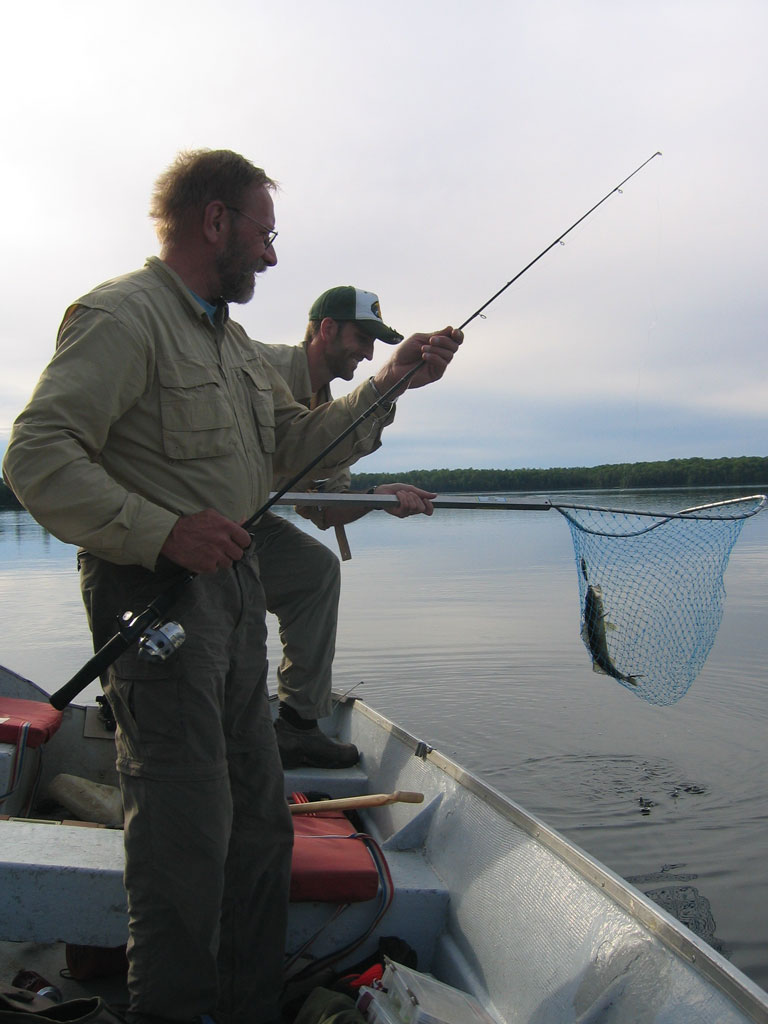
The fish fought for about 15 minutes, and at one point was more than 200 feet off the back of the boat. It was good to see Scott start to fatigue a bit as he got his first taste of horsing in a big one. Finally we tired out the salmon more than Scott, and unlike last year, I actually had a big enough net to get the fish in the boat.

Scott’s Salmon
15 lb. King Salmon

Kris with salmon
Striking a pose with the catch of the day

It was awesome to find out that the fish came on grandpa’s rod, and the ‘Dancing Hula Girl’. Thanks gramps, that was pretty cool! Scott and I both had a big smile on our face the rest of the morning even though we never got another hit. I went home and cleaned our fish, then Tricia and I cooked it for dinner on the grill. Grilled salmon marinated in Santa Fe Marinade is mmm…mmm…good.

This was enough excitement to last me until next year. I think Scott was pretty pumped because when I dropped him off his vacuum packed fillets at church today (good charter captain I am) he still was sporting that grin. Thanks for a fun morning Scott!

Posted in: Fishing, Life | 1 Comment »
Share/Save/Bookmark

DIY Basement Workout Room Step 3: Electricity and Ceiling the Messy Way

Sun, 07 September 2008

With the wall insulation installed, it was now time for me to figure out the electricity for the basement workout room. I’m definitely NOT an electrician, so this posting isn’t going to give you any details on how to run circuits. I had a friend who knows what he’s doing stop by and help me plan out the circuits. Here’s a few decisions we made that might be helpful.

  • We decided on some 20Amp outlets for the treadmill and other heavy-load equipment.
  • The basement already had 1 lighting circuit, so we planned a second, new lighting circuit to be run from the box. We planned it as a 3-way circuit so that the workout room could be switched from 2 different switches entering and exiting the room.
  • We created a dedicated circuit just for the sump pump so that there would never be a potential overload on that circuit
  • My advice to you is to Google the different things you need to install + circuit diagram, and you’ll get VERY useful resources like this 3 way circuit diagram. These diagrams, plus my friend’s advice lead me to the store to get all the wire and boxes I would need.

    How I ran the Electric in the Styrofoam Insulation
    First, we needed to figure out how we’d attach electrical boxes with the lack of studs in the walls. Sure, I could have attached the boxes directly to the block wall and cut the Styrofoam panels around them. I wanted to poke as few holes in the Styrofoam as possible to retain its insulation factor. So, we chose to use old work plastic electrical boxes. These are the kind that get attached via tabs to the back of the dry wall instead of to the studs. While you may argue this is a less secure solution for the electrical boxes, it ended up being far easier to install and secure enough for my needs when all was said and done.

    The installation guide recommended running the electric wires behind the Styrofoam board. I wanted to be able to easily see my wiring paths so I chose to embed the wiring on the front of the styrofoam. First, I drew lines with permanent marker on the foam board to all of my proposed electrical outlet locations. I created a template out of cardboard that provided enough clearance for the electrical boxes and traced those in the electrical box locations.

    Here’s where the job got messy. To be able to easily cut the paths in the Styrofoam, I purchased a 5/8″ bit for my plunge router. Then I went crazy routing out the paths. Luckily I had tarped off the other parts of the basement, because the Styrofoam bits went everywhere! Make sure to wear safety goggles and a breather because the bits are not kind to your eyes or lungs. Have a look at the pics of me in action to get a sense of the mess.

    Routing out the Electric paths
    The paths were drawn in marker and I ran the router over the lines.

    Covered in Styrofoam dust
    A router can make a huge Styrofoam cloud

    To get the paths behind the furring strips just use a half inch drill bit and drill behind both sides of the furring strips. After all of the paths were routed out, I easily ran the rough wiring to all of the electrical box locations, leaving plenty of wire to finish things off after the boxes get installed with the drywall.

    Painting the Ceiling with a Wagner Power Painter
    While the walls were still bare it was time to make a crucial decision – how to finish the ceiling. We considered all of the various finishing options and finally arrived at an approach I’ve used once before; painting the ceiling with a Wagner Power Painter. Here’s why painting the ceiling makes a ton of sense for us.

    1. It’s a LOT cheaper. A tile ceiling with all of its associated hanging hardware would have cost $600-$1000. Painting the ceiling cost us two gallons of paint, about 40 bucks.
    2. It’s a lot higher. When I’m working out, I need all the space I can get for my monkey arms. Not having a drop ceiling saves us a precious few inches.
    3. It’s a lot more accessible. No ceiling tiles to mess with if you need to get at wiring or plumbing in the floor joists.
    4. It’s a lot easier and faster. Installing a drop ceiling takes a ton of time to install the grid work, cut the tiles, and soffet all of the irregular areas. Painting is a one shot deal that can be finished in a few hours.

    Choosing Your Paint Color
    Think of this ceiling method as the coffee shop, or industrial approach. We’ve all been to those trendy places with the exposed beams and pipeworks, same idea with your basement. I think the best colors to choose are anything dark. At my last house we used black. In this case, we used a dark gray. I’ve also seen dark brown and terra cotta – both look good. The ceiling just fades into the background not drawing your eye’s attention. What doesn’t look good in my opinion is a white or light painted ceiling. As soon as you enter a basement with the white painted beams, your eye is immediately drawn to it making it a lot more noticeable.

    Ceiling Paint Supplies
    If you choose this approach you’ll need a few critical supplies.

    1. Wagner Power Painter. Mine is the Wagner 5.4 Wideshot
    2. Floetrol or similar paint additive to thin your latex paint for spraying
    3. Latex Paint. I used 2 gallon of Eggshell finish for approximately 600 Sq ft.
    4. Rubber Gloves
    5. Protective head scarf, safety goggles and high quality breather
    6. Masking materials – tape, plastic, etc.

    Make sure to mask off anything that you do not want painted. Tarp doorways and passages to other rooms in your basement. Turn off your heat and/or air conditioner so that the fumes do not travel through the house. Open any basement windows you have for ventilation.

    Making the Big Mess
    Prepare yourself…this is going to make a big mess. By the time you are done painting, you will have paint dust all over your floors. Put the hood on your head, your rubber gloves on, and put on your safety goggles. Then fill your paint container with paint and some Floetrol and stir it up. Then go nuts spraying that ceiling. I like to have a scrap board nearby to take my initial spray shots so that the paint is flowing smoothly. Have a look at the pictures of Darth Painter to see it in action.

    Paint Vader 1
    I am your father…

    Paint Vader 2
    This sure beats painting with a brush

    Paint Vader 3
    Spray it on nice and thick to cover every nook and cranny

    In my next entry I’ll catch you up on our mudding and taping fun, show you the closet that will contain the sump pump, and I’ll show you the rubber floor installation.


    DIY Basement Workout Room: Step 1 | Step 2 | Step 3 | Step 4 | Step 5

Posted in: Home Improvement, Life | 6 Comments »
Share/Save/Bookmark

DIY Basement Workout Room Step 2: Insulating the Walls

Thu, 28 August 2008

Who knew that one of the most time consuming tasks in finishing the basement would be figuring out how to construct the walls. I agonized over the approach I would take, knowing that the wrong decision could cause me to tear down everything and start over. I hope my story here will help you make a good decision too.

The Walls I’m Working With
My house was built in 2005. We chose the particular lot we are on because it seemed like high ground with respect to other homes in the neighborhood. The walls are constructed of 12 courses of cement block which, despite my location, get saturated in different areas during heavy rains. I was shocked that a brand new basement could be so porous to water. I don’t get streams, but I would not say the basement is bone dry either. If we run a dehumidifier on high after a few days of dry weather the walls will dry out.

Last year I called EverDry in frustration, hoping that they could diagnose the water problem and propose a remedy. After the doom and gloom sales pitch of the dangers of deadly mold and crumbling foundations, their solution came out to a cool $17,000. It involved digging out around the outside of the foundation, trenching the interior perimeter of the basement and installing an industrial dehumidifier. This would guarantee dry block and also $17k less in my bank account. I decided to finish the walls without the massive expense, but the specter of water made my decision making far more stressful.

The Vapor Barrier Decision
The builder had originally planted the seed that putting a vapor barrier against the block walls (even if damp) leaving an airspace, and installing 2×4 studs would be a suitable way to finish the walls. I had a ton of questions about EXACTLY what to do though.

  • What kind of plastic should I use?
  • How far away from the walls should the studs be?
  • Should I install fiberglass insulation between the studs?
  • Do I need a pressure treated floor plate?
  • The most nagging of all questions: Will the walls get wet on the inside if I use this approach?

To answer my questions I followed Google to this great forum entry on how to vapor barrier a basement. There were some differing opinions, but THE BEST resource was referenced; Building Science Corporation’s Basement Insulation Systems Guide. Hallelujah! This is the advice given to builders on how to insulate/finish a basement. It has detailed pictures of the effects of what my builder had suggested (putting up a plastic vapor barrier and insulation)…it retains water and mold. MY solution was found on page 13 of the guide which explains the use of extruded polystyrene insulation and furring strips.

The Dow Styrofoam Solution
With a solution in mind I went looking for where I could find this extruded polystyrene (EPS). Lowes saved the day again. I found 2″ thick EPS sheets in either 4×8′ or 2×8′ tongue and groove sheets. Then I wanted to know how to install the stuff. Lo and behold the Dow website has this very thorough Dow Styrofoam Wallmate XPS Installation Guide. It gave me the plan I needed to purchase the rest of my materials, which included 1×3 furring strips for every 2′ and plenty of Tapcon screws.

A Special Note on the Tapcon Screws
For my project thickness the right size Tapcon screw was the 1/4″ x 3 3/4″ HEX head Tapcon screws. First, they are the thick ones to prevent any chance of them snapping on me when I installed them. Secondly, you MUST use the hex head for ease of screwing it into concrete. Don’t even think of using a Phillips head or flat head. Finally, buy a LOT of them, and NOT at Lowes. Tapcon screws are insanely expensive there, and these big ones run out of stock. I probably used 6-8 boxes of 25 screws each to do my single room. Buy them online in bulk if you can.

The Right Mix of Tools and Technique
It took me a couple of nights to get into a rhythm of how to best install the stuff. Let’s start with tools because they mean the difference between extremely slow, and super efficient. You’ll need:

  • Tape measure
  • Drywall square
  • Permanent marker
  • Utility knife
  • Spare 2×4′ board
  • High power CORDED hammer drill for drilling concrete
  • High quality masonry drill bit
  • Another electric drill for drilling countersink
  • Cordless drill/driver for installing Tapcon screws
  • Hand ratchet for finishing off stubborn Tapcon screws
  • Chop saw for cutting furring strips to length
  • Level to ensure furring strips and styrofoam are plumb
  • Ear protection
  • Work gloves

Tools for installing EPS Insulation
A menagerie of Craftsman tools helped me efficiently install the insulation

Working from one corner of the room, you begin by cutting the styrofoam to the height of the block wall so that it fits underneath the floor joists. To cut the material I marked a line with a framing square and permanent marker, then scored the line with a utility knife. The final step was to break the styrofoam over a spare 2×4 as shown below.

Breaking the insulation

Once a couple of pieces of styrofoam are dry-fit into place, you then cut a furring strip to cover the seem between them. Using a level I made sure that the furring strip was vertical, and had my trusty assistant hold it while I went for the hammer drill…

A Special Note on Hammer Drills and Bits
Not all hammer drills are made alike, and neither are masonry drill bits. Trust me. The first rig I used was my Craftsman 19.2V Cordless with the 3/16″ bit provided in the screw box by Tapcon. That was slow and painful. Then I thought I’d try my dad’s Black and Decker corded hammer drill from the 1980s thinking the electric power would help. Nope. I nearly burned out the drill. Check out the lean and grimace I’ve got trying to use that sorry rig.

Hammer drilling

So, I went to Kmart and bought a reasonably priced Craftsman corded hammer drill, and I went to Lowes and bought the toughest sounding 3/16″ masonry bit they had – the Bosch Blue Granite 6″ long Hammer drill bit. This combination cut through concrete like butta, and made this portion of the project take days not weeks!

Drilling and Screwing With Protection
I’m obliged to warn you that I used protection when hammer drilling and screwing. Muffs for the ears and gloves for the hands (padded for my pleasure). The sound reverbed throughout the basement and could have spread a WTD (Work Transmitted Disease). Without gloves, my hands would have developed some nasty sores. OK, enough with the stupid jokes…

  1. I drilled into the concrete
  2. I countersunk the hole
  3. I drove in the Tapcon with the cordless drill and hex driver
  4. I finished off the screw with a ratchet when needed

The end result is a securely fastened piece of Styrofoam insulation with Tapcon screws that are flush on the front so that drywall can be installed directly onto the furring strips without obstruction.

Countersink the furring strips
Closeup of furring strip with countersunk Tapcon screw

Finished Insulated wall
The insulated basement wall completed

This portion of the project took about 5 days, and the end result was actually really fulfilling. I could have very easily left the basement looking like this. It is now insulated, and the blue looks much better than block. Unfortunately I think there is some code that says you need to cover over the Styrofoamwith wall board for fire protection. Well…that and we can’t have Tricia’s clients working out in a half-finished room, now can we?

Next up…how I installed the electricity and painted the ceiling with a Wagner Power Painter.


DIY Basement Workout Room: Step 1 | Step 2 | Step 3 | Step 4 | Step 5

Posted in: Home Improvement, Life | 17 Comments »
Share/Save/Bookmark

“24″ in 1994. Check out the Old School Internet.

Mon, 11 August 2008

This is a great spoof video showing the show 24 as if it were 1994. It reminds me of how far we’ve come in a very short period of time. I love when the boss picks up the phone and cuts off AOL – priceless. There isn’t any point in trying to explain vinyl records and cassette tapes to my kids anymore. Even the interweb look vastly different than it did before they were born. They’ve never even heard modem tones.

Posted in: Life, TV | No Comments »
Share/Save/Bookmark

DIY Basement Workout Room Step 1: The Plan

Thu, 07 August 2008

1037 Castle Bridge Basement Plan

My web activities have slowed to a crawl as we have begun yet another home improvement project in the Rzepkowski household. This time we are finishing an area of our basement to serve as a workout room for Tricia’s personal training business. My web marketing strategery caused an inflow of clients a few months before she may have been fully prepared, so here we are in the middle of the best part of summer locking ourselves “down in the hole” to prep some much needed home fitness space.

I’m going to post a series of entries outlining the project. I’ll try to write down as many notes-to-self as possible so that I don’t make the same mistakes again the next time I go to do some DIY home improvement. If you learn from any of the choices I make, awesome! If you want to comment on what an idiot I am, go for it! I’m way behind on documenting the steps I’ve already done so your advice will likely fall into the too little too late department. Without further ado, let’s get going…

What Are We Going to Do?
This whole thing started with a simple wife whimper, “Honey, I really need a wall between this one part of the basement and the other part so that all the kids’ junk isn’t in the way of my workout sessions.” I said, “OK, a simple stud wall with a door opening will be no problem. Let’s just put it up. So, I got the car keys and just as I was stepping out the door to go to Lowes I thought, “Gee, maybe I should measure a few things.” I brought my expert consultant to the basement and we literally moved furniture around for an hour trying to figure out how to configure the space.

Visio 2003 Beats the Back of a Napkin
After we tired ourselves out, we decided a floor plan was in order. I popped open Visio Professional 2003 on my computer and draw up a plan of the space and the big items we needed to fit. That way the heavy lifting would be done on the computer, not with our back. The plan you see is by no means an expert architectural blueprint. I misused and abused Visio because I didn’t want to spend the time to learn how to do it 100% right. I wanted to get building the friggin’ basement, not become a Visio Jedi Master. Nonetheless here were a few brief tips on how I made a simple drawing above out of Visio.

  1. Create a New Drawing by going to New > Building Plan > Floor Plan. This opens a ton of VERY helpful Visio shapes for creating walls, staircases, furniture, dimensions, etc
  2. Set the Scale under Page Setup > Drawing Scale tab. Measure you long outside walls and fiddle with the scale so that the entire drawing will fit on 8.5 x 11. Trust me, you at least want to do the drawing to scale. This is extremely helpful!
  3. Use the shapes in the Dimensioning – Architectural palette to show precise measurements on your drawing. These measurements allow you to measure on paper for everything from studs to wiring.

The left side of the drawing is what we are currently building. The rest (including the bathroom) are for a future phase. Learn about the tough decisions we made on insulating and waterproofing cement block walls in my next posting.


DIY Basement Workout Room: Step 1 | Step 2 | Step 3 | Step 4 | Step 5

Posted in: Home Improvement, Life | 2 Comments »
Share/Save/Bookmark

lifecategories

wifeblog

Cubmaster

dailyReads

wishlist

from kaboodle
aboutkris

This is my Life as a 36 year old husband and father of two and my Work as an Interactive Marketing Director currently telecommuting to Hudson in Chicago from home in Rochester, NY.
more about me...

archivedkris

shades of k © 2000-2011, Kris Rzepkowski | powered by: WordPress, hosted by: Bluehost